Ubuntu Life Resources is a registered United Nations Global Marketplace vendor, a UNICEF registered vendor, and a corporate member of IWA and WISA.
- UNGM
- 5618342United Nations Global Marketplace
- UNICEF
- Vendor UNGM 5618343Registered vendor
- IWA
- 16142154International Water Association
- WISA
- 10242Water Institute of Southern Africa
Unsafe water creates health and economic risk
Over 2.2 billion people globally lack access to safe drinking water, leading to disease, economic loss, and reduced quality of life.
The solution: SANI AMANZI™ is a point-of-use water purification solution designed for governments, NGOs, rural communities, farms, and livestock operations.
Performance includes 99.99% pathogen removal, elimination of E. coli, Salmonella, and Cholera, and alignment with SANS drinking water standards even in highly contaminated environments.
Simple four-step field process
Add 6g sachet to 20L water
Start with measured dosage for consistent treatment.
Stir and activate
Ensure complete activation throughout the water volume.
Allow 30 minutes
Wait for treatment cycle completion before consumption.
Five steps every operator follows
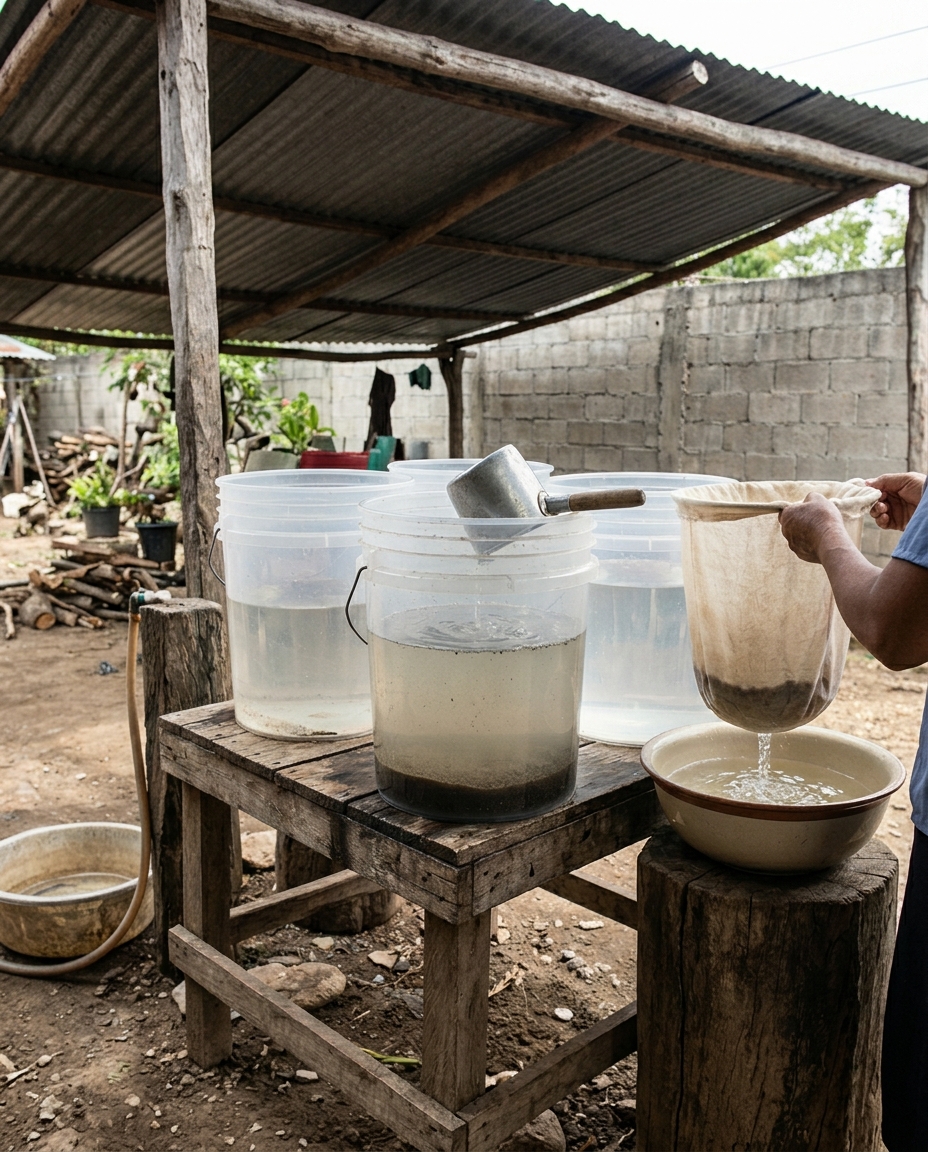
- Collect 20 L of raw water in a clean vessel.
- Dose one sealed 6 g sachet (or bulk equivalent from your dosing chart).
- Agitate vigorously for 1–2 minutes to dissolve actives and start flocculation.
- Rest 30 minutes undisturbed for kill kinetics and settling.
- Decant / filter the supernatant through a clean cloth into a storage container; never drink the sludge layer that concentrates metals and debris.
Targets cited in lab packs
SANAS-recognised laboratory work quoted by the manufacturer demonstrates aggressive reduction of faecal coliforms, including Vibrio cholerae, Salmonella spp., Shigella spp., and generic E. coli down to near-zero counts per 100 mL when the dwell time is respected.
Developers also highlight retained performance against selected antibiotic-resistant phenotypes, relevant where superbugs move through informal water networks.
Proven treatment performance
Pathogen reduction
Removes 99.99% of pathogens in treatment workflows.
Disease targets
Eliminates E. coli, Salmonella, and Cholera where protocol is followed.
Standards
Meets SANS drinking water standards for intended use cases.
Contaminated environments
Effective even in highly contaminated water settings.
Key benefits
Chlorine-free purification and precise dosage reduce overdose risk.
Portability & sustainability
Portable, scalable, and environmentally sustainable for field use.
Programmes that need documentation
We help align certified treatment narratives with procurement, field teams, and monitoring requirements. For depth on water purification solutions, see water purification solutions.
Technical pack
Request the protocol summary and, where available, the full technical guidelines for your context.
Municipal & emergency
Conversations for boreholes, trucked water, and temporary supply lines.
Traceable supply
Named product lines and batch-aware procurement where your governance requires it.
Image slots for water story assets
Related products
Enquire
Sanchia-Lynn Smit, CEO / Founder
Deliver safe water where it matters most.